Personal training provides structured, one-to-one coaching tailored to your individual goals, fitness level, and schedule. A qualified personal trainer designs your programme, teaches correct exercise technique, manages your nutrition plan, and provides the accountability that makes consistent progress far more likely than training alone.
Key Takeaways
- A personal trainer creates a fully bespoke programme based on your goals, lifestyle, and current fitness level
- Correct exercise technique reduces injury risk and ensures you get the most from every session
- Nutritional guidance alongside training accelerates results — a trainer helps you create a sustainable calorie deficit
- Accountability is one of the biggest benefits; booking sessions in advance makes you far more likely to show up
- Personal training suits all levels, from complete beginners to experienced lifters seeking new challenges
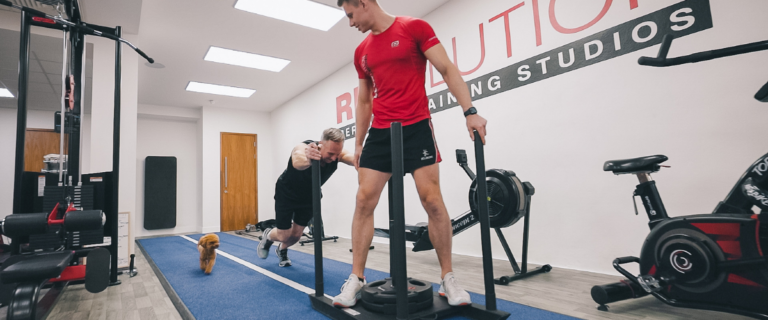
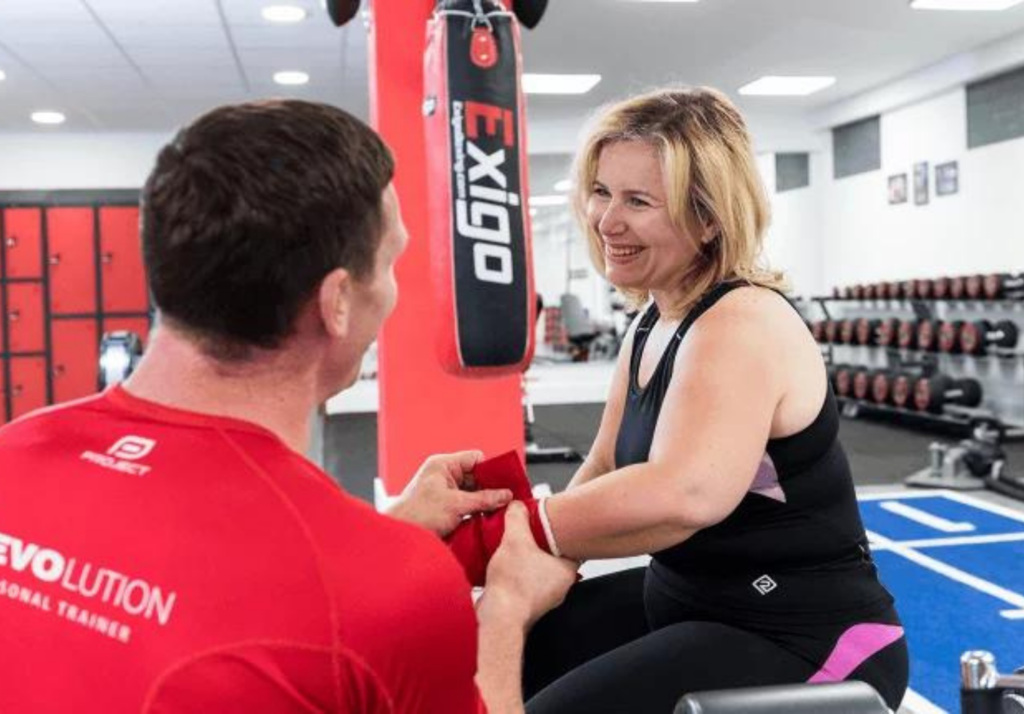
We have created a friendly, welcoming and completely non-judgemental personal training studio.
This setup allows you to be flexible with the days and times that suit you best to train. Ultimately, your personal trainer will work around you and your schedule to ensure that exercise and wellbeing become part of your lifestyle.
Some clients who train at Revolution are not looking for a 12 week transformation. It may be that you want to drop half a stone in weight, train for a 5k event or simply use exercise to reduce stress.
Whatever your training goal, your personal trainer will make sure that you execute all exercises safely, effectively and with confidence. Goal setting, a personalised training and nutritional plan, and regular evaluation of your progress are the Revolution principles that will lead you to success.

Can a personal trainer help me lose weight/achieve my goal?
Your personal trainer will make sure that your training and nutritional plans are completely bespoke for you and that they also take into account your work, family life and any other commitments you may have. Your training plan will make sure you have enough time to physically recover in between your sessions, but will also encourage you to increase your activity levels in your own time.
By educating you on how best to track your food intake, your personal trainer will help you to be in a small and manageable calorie deficit (which is essential for weight loss) whilst still eating the foods you enjoy at the right times. This approach, combined with helping you establish regular and consistent training habits and routines, will make sure you lose weight and keep the weight off in the long term.

When should you consider hiring a personal trainer?
A personal trainer is a great investment for people at any stage of their fitness journey.
For beginners, hiring a personal trainer will ensure you are given really good foundations on which to build upon, which means you’ll be lifting weights with the correct technique and gaining an understanding of how best to measure your progress over time. Through the use of a food diary, your trainer will work with you to identify what foods you over-consume and what you may need to eat more of. This awareness is the first step towards making nutritional changes that are both sustainable for you in the long term and drive you towards your goals.
For those at an intermediate training level of fitness, you’ll gain an understanding and confidence on what exercises you’re executing well and which movements you can improve upon technically. You’ll benefit from a fresh perspective and new training ideas that your trainer will incorporate into your training plan. From a nutritional perspective, your personal trainer will provide you with recipe ideas and meal plans which will guide you to make sustainable improvements that fit in with your lifestyle.
For those with a high level of fitness, a personal trainer will look at every detail of your health. This will include your training plan, nutritional plan and lifestyle (including rest days, sleep quality, macro and micro nutritional intake). Alongside this, your training will be optimised and the combination of all these factors will lead to gaining that extra 10% in your performance, physique and health.

Is a personal trainer worth it?
Many people have spent large amounts of money and time trying, unsuccessfully, to reach their health and fitness goals. Money spent on unused gym memberships or home exercise equipment that gets used to hang clothes on are, unfortunately, commonplace. A personal trainer helps you to gain clarity on what goals you want to achieve and how you’re going to get there.
During the training sessions with your personal trainer, you’ll be pushed to reach your physical potential in a safe and effective way. Accountability is another key aspect of why hiring a personal trainer is so much more effective than training on your own. The benefit of having someone to answer to, someone to encourage you and someone to keep you on track cannot be overlooked.
What to Expect from Your First Month of Personal Training
The first four weeks of personal training focus on building foundations. Your trainer will teach you the correct technique for fundamental compound movements — squats, deadlifts, rows, and pressing exercises — and progressively increase the load as your form improves. This phase is about learning movement patterns, not chasing heavy weights.
During this period, your trainer will also establish your nutritional baseline. This typically involves keeping a food diary for 1–2 weeks so that your trainer can identify areas for improvement. Rather than overhauling your entire diet overnight, most effective coaches make small, incremental adjustments — reducing portion sizes slightly, increasing protein intake, or swapping calorie-dense snacks for more satiating alternatives.
By the end of the first month, most clients report improved energy levels, better sleep quality, and increased confidence in the gym. Measurable strength improvements typically follow within 4–6 weeks, while visible body composition changes usually become apparent around weeks 6–8 for those maintaining a consistent calorie deficit.
Who Benefits Most from Personal Training?
Personal training is beneficial at every stage of a fitness journey, but certain groups tend to see the greatest return on investment. Complete beginners benefit from learning correct technique from the outset, avoiding the bad habits and injury risk that come from self-taught training. Research from the Journal of Strength and Conditioning Research confirms that supervised trainees achieve significantly greater strength gains than those training alone.
People returning to exercise after a long break, injury, or pregnancy also benefit enormously from professional guidance. A trainer can modify exercises around limitations, progress at an appropriate pace, and provide the structure needed to rebuild a consistent routine. Similarly, experienced lifters who have hit a plateau often find that a fresh perspective on programming and technique unlocks new progress they could not achieve independently.
Frequently Asked Questions
What happens in a first personal training session?
A first session typically includes a consultation covering your goals, medical history, current activity levels, and any injuries or limitations. Your trainer will assess your movement quality through basic exercises, discuss your nutrition habits, and outline a plan for the coming weeks. The focus is on establishing a baseline and building rapport, not pushing you to your limits on day one.
How many personal training sessions per week do I need?
For most people, 2–3 sessions per week is optimal. The ACSM (American College of Sports Medicine) recommends resistance training each major muscle group 2–3 times per week for strength and body composition improvements. Your trainer will typically supplement these sessions with a home programme including daily step targets and additional activity you can do independently.
Is personal training worth the investment?
Research published in the Journal of Sports Science and Medicine found that individuals who trained with a personal trainer selected higher training intensities and achieved greater improvements in strength compared to those training alone. The combination of expert programming, technique coaching, nutritional guidance, and accountability makes personal training one of the most effective investments in long-term health and body composition.
Can personal training help with goals beyond weight loss?
Absolutely. Personal training is suited to any fitness goal, whether you want to lose half a stone, train for a 5k event, build muscle, rehabilitate an injury, or simply use exercise to reduce stress. Your trainer creates a bespoke programme based on your specific objectives and adjusts it as you progress.
What should I expect during the first month of personal training?
The first four weeks focus on building foundations. Your trainer teaches correct technique for fundamental compound movements, progressively increases the load as your form improves, and establishes your nutritional baseline through a food diary. By the end of the first month, most clients report improved energy, better sleep, and increased confidence.
Who benefits most from personal training?
Complete beginners benefit from learning correct technique from the outset and avoiding injury. People returning to exercise after a long break, injury, or pregnancy benefit from professional guidance and appropriate progression. Experienced lifters who have hit a plateau often find that a fresh perspective on programming unlocks new progress.
How does a personal trainer help with nutrition as well as training?
Your trainer helps you track food intake through a food diary so that both of you can monitor what you are eating and drinking. This creates accountability and allows your trainer to recommend targeted nutritional changes, such as reducing portion sizes slightly or increasing protein intake, to support your calorie deficit and training goals.
Sources & References
- ACSM Guidelines for Exercise Testing and Prescription (11th Edition) — Recommends resistance training 2–3 times per week for health and body composition benefits
- Mazzetti et al. (2000), Journal of Strength and Conditioning Research — Found that supervised trainees achieved greater strength gains than unsupervised trainees over 12 weeks
- NHS — Exercise guidelines for adults — Recommends 150 minutes of moderate activity plus strength exercises on 2 or more days per week