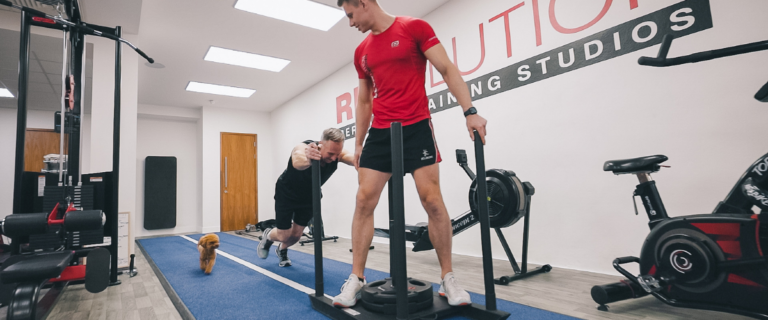

A 12-week body transformation is achievable with a clear goal, a structured training and nutrition plan, and consistent effort. The programme typically includes goal setting, progressive resistance training, nutritional coaching, and regular progress reviews. Most clients see measurable changes in body composition, strength, and energy levels within this timeframe.
Key Takeaways
- A detailed goal-setting session at the start defines your target and — critically — your personal ‘why’
- 12 weeks is long enough for meaningful body composition changes but requires consistent weekly effort
- Expect the first 4 weeks to focus on building habits and technique before intensity increases
- Plateaus are normal mid-programme — your trainer adjusts your plan to keep progress moving
- Most clients choose to set a new goal after 12 weeks rather than stopping, because momentum builds on itself
Is a 12-week body transformation possible?
Before you set off on any major journey, you must have a detailed plan of action in place. However, before a health and fitness plan can be built, it’s essential that you understand exactly what you want to achieve physically.
Understanding this can be achieved through a detailed goal setting session with your personal trainer. After your goal setting session, you’ll be really clear on what your goal is and just as importantly why you want to transform your body. That ‘why’ is deeply personal and perhaps the key aspect to succeeding, as it is what will drive you on to push through the challenges and obstacles that will inevitably come up during the twelve weeks.
Once you have a personalised plan in place, then the hard work truly starts and it’s here that you’ll need to display a variety of positive character traits. These include perseverance, patience, determination and willingness to trust the process, particularly when you don’t have all the answers or the way forward seems unclear. Your personal trainer will support and guide you throughout the whole 12 week process, providing advice, encouragement and accountability along the way.
Achieving a 12-week body transformation is not easy, but with a clear vision, the right plan and enough hard work it is absolutely possible.

How will I feel when I finish my transformation?
After finishing your 12-week transformation, you’ll feel a huge sense of pride in your achievement – of how your body has improved from both an aesthetic and athletic perspective, and how much more energy you have. You’ll feel more motivated than ever, because you made a promise to yourself and you delivered on that promise.
Clients also feel incredibly positive after a body transformation because many had previously doubted whether it was possible for them to achieve their goal. This leads many clients to question what else they could achieve in other areas of their life that they previously didn’t think was possible.
Some people also feel a sense of sadness that their 12-week body transformation is over, so at this point you have two choices – one option is to slip back into old habits and routines and slowly start to lose your hard earned strength and fitness. The second option (which most of our clients take) is to set a new goal that excites you and motivates you to drive on to reach your full potential. The choice is yours…

How does a 12-week transformation work?
The starting point for a 12-week transformation is to have a clear goal of what you want to achieve and why. Write your goal down and share it with supportive friends and family.
The next step is to assess where you’re at physically today. Your personal trainer will do this by measuring your body fat, weight and a simple tape measurement of your waist, hips and arms. A photo will also be taken from the front, side and back to help with reviewing your progress regularly throughout the 12 weeks.
Your training plan will be devised based on your current level of physical fitness and what your specific goal is. It’s really important that you train consistently and with focus, as building habits and routines around exercise will be paramount to your success. You will then be asked to keep a food diary so that both you and your trainer can track what you’re eating and drinking. Recording your nutritional habits is vital as it will make you and your trainer aware of any food and drinks you might be currently over-consuming, and also help your trainer to recommend any nutritional changes that will help you towards your goal.
You will then implement the plan your trainer has laid out for you, which will usually include training with weights 3 to 4 times per week. Regular evaluation in the form of weigh-ins and/or body fat measurements is vital, as this acts as direct feedback on the effectiveness of your training and nutritional plan. Tweaks and changes can then be made to your training and nutritional plan, and this process is repeated throughout your 12-week transformation.
At the end of your 12-week transformation, you will have all your measurements retaken as well as those all important ‘after’ photos. This visual reminder of your progress and achievement is incredibly powerful.
What Happens During Each Phase of a 12-Week Programme
Weeks 1–4 — Foundation Phase: The first month focuses on establishing habits, learning correct exercise technique, and setting your nutritional baseline. Your trainer will assess your movement quality, introduce fundamental compound exercises, and help you start tracking your food intake. The goal is building consistency rather than intensity. Most clients train 2–3 times per week and establish a daily step target.
Weeks 5–8 — Progression Phase: With technique established, training intensity increases progressively. Weights get heavier, sessions become more challenging, and your trainer fine-tunes your nutrition based on your first month of tracking data. This is typically where visible body composition changes begin to appear. If a plateau occurs, your trainer adjusts training volume, calorie targets, or both.
Weeks 9–12 — Peak and Consolidation: The final phase pushes you towards your goal with peak training intensity while ensuring recovery is managed. Your trainer conducts a final progress review comparing measurements, strength levels, and photos from week one. The last week includes a transition plan — whether that means moving to maintenance calories or setting your next goal.
Why 12 Weeks Works: The Science of Habit Formation
The 12-week timeframe is not arbitrary. Research from University College London published in the European Journal of Social Psychology found that it takes an average of 66 days — roughly 9–10 weeks — for a new behaviour to become automatic. A 12-week programme provides enough time for new habits to form and an additional 2–3 weeks to reinforce them.
This is why short-term challenges (21 days, 30 days) rarely produce lasting change — they end before the new behaviour has become habitual. By contrast, after 12 weeks of consistent training and nutritional awareness, most people find that their new routine feels normal rather than effortful. The exercise sessions, the food tracking, and the daily movement are no longer something they have to force themselves to do; they have become part of their identity.
Frequently Asked Questions
How much weight can I realistically lose in 12 weeks?
At a safe and sustainable rate of 0.5–1 kg per week (as recommended by the NHS), you can expect to lose between 6 and 12 kg of body fat over 12 weeks. The exact amount depends on your starting point, adherence to your nutrition plan, and training consistency. People with more weight to lose often see faster initial results.
What does a typical week look like during a 12-week transformation?
A typical week includes 2–3 personal training sessions focused on progressive resistance training, a daily step target of 8,000–10,000 steps, and a structured nutrition plan with a moderate calorie deficit. Your trainer reviews your food diary weekly and adjusts your plan as needed. Rest days are built in for recovery — overtraining is counterproductive.
What happens after the 12 weeks are finished?
After completing a transformation, you have two main options: transition to a maintenance phase to consolidate your results, or set a new goal and continue progressing. Most clients find that the habits they have built over 12 weeks — regular training, mindful eating, and daily movement — have become part of their routine and are easy to maintain.
Why is 12 weeks an effective timeframe for a body transformation?
Research from University College London found that it takes an average of 66 days for a new behaviour to become automatic. A 12-week programme provides enough time for new exercise and nutrition habits to form and an additional two to three weeks to reinforce them, making the changes more likely to stick long-term.
What character traits are needed for a successful 12-week transformation?
Successful transformations require perseverance, patience, determination, and a willingness to trust the process. There will be moments when progress feels slow or the way forward seems unclear. Your personal trainer provides support, encouragement, and accountability throughout the entire 12-week journey.
How is progress tracked during a 12-week programme?
Your personal trainer measures body fat, weight, and tape measurements of your waist, hips, and arms at the start and throughout the programme. Photos are taken from the front, side, and back for visual comparison. Regular evaluation provides direct feedback on the effectiveness of your training and nutritional plan.
What are the different phases of a 12-week transformation?
The programme typically divides into three phases: weeks one to four focus on building habits, learning correct technique, and setting your nutritional baseline. Weeks five to eight increase training intensity and fine-tune nutrition based on tracking data. Weeks nine to twelve push you towards your goal with peak intensity and include a transition plan for afterwards.
Sources & References
- NHS — Start losing weight — Recommends a target of 0.5–1 kg per week for safe, sustainable weight loss
- Schoenfeld et al. (2017), Journal of Strength and Conditioning Research — Meta-analysis showing progressive resistance training 2–3 times per week optimises muscle retention during fat loss
- Lally et al. (2010), European Journal of Social Psychology — Found that habit formation takes an average of 66 days, supporting the 12-week programme length for lasting behaviour change